From Seed to Table:
The work of Semillas de Vida Foundation
Tania Monserratt Téllez Serrano / Malin JönssonAugust 11, 20265 min read
Food does more than nourishing the physical body; it is a living narrative that documents people’s history, their resistance, their identity, and their intrinsic relationship with the territory they inhabit.
Here at Comida Contada, where culinary narratives converge and take on meaning for the reader, we believe it is essential to invite reflection and turn our gaze back to the primordial origin of everything that reaches our plates: the seed. At Semillas de Vida Foundation, A.C., we work every day, driven by the deep conviction that the quality of our food, the health of our population, and the future of our cultural heritage depend, inevitably, on the seeds and the campesino hands that safeguard and select them cycle after cycle.
We are a civil society organization that, since 2007, has worked to protect native seeds while revaluing food culture, campesino labor, and campesino knowledge. We seek to position ourselves as a counterweight to the privatization of seeds, the abandonment of the Mexican countryside, corporate control of food, and the imposition of free trade agreements.
Our projects
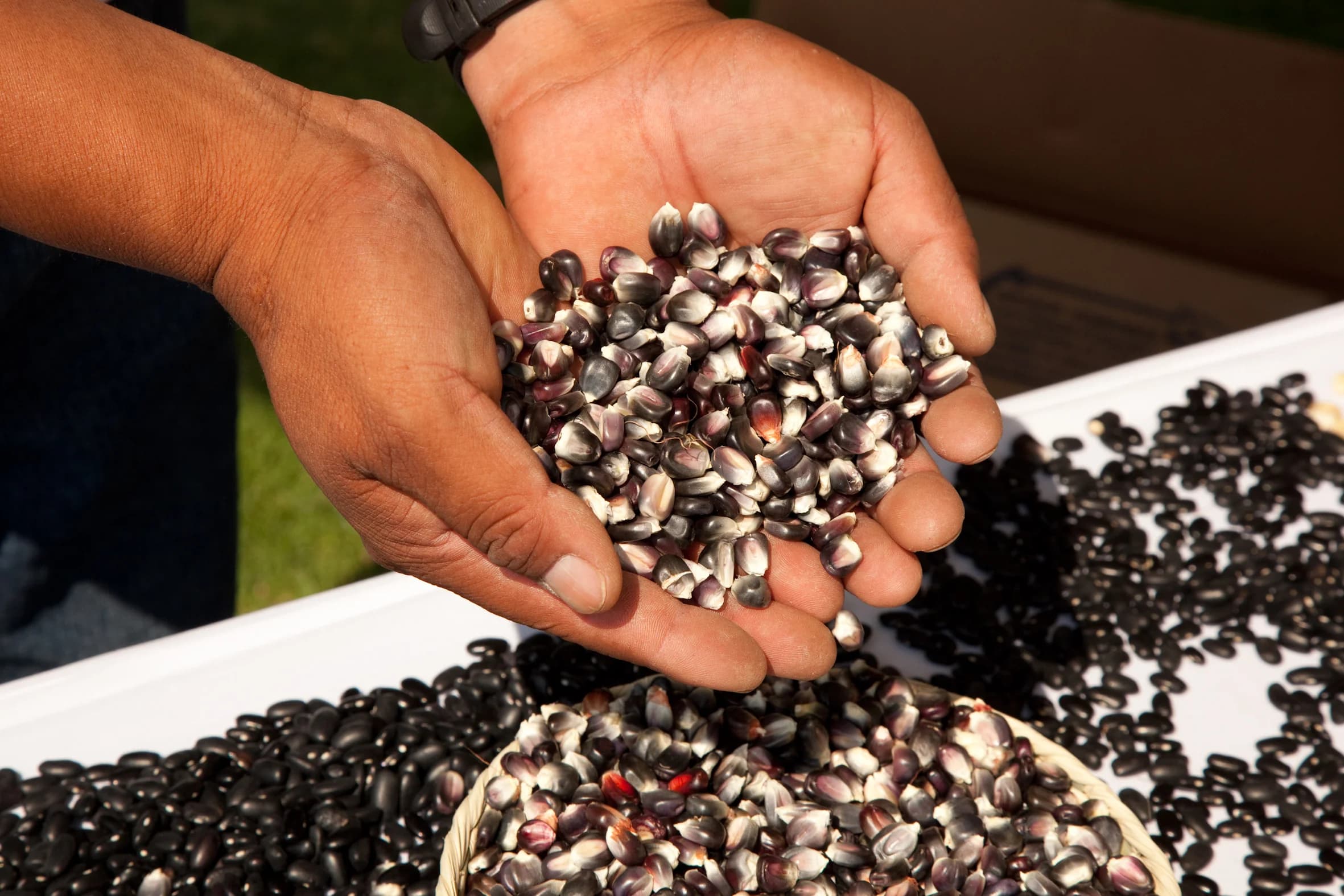
To understand our work, it is essential to begin with the fact that Mexico is the center of origin, domestication, and diversification of maize. However, this grain does not exist in isolation; its natural, biological, and cultural habitat is the milpa and the campesino and Indigenous peoples and communities of our country. The milpa system represents one of the most complex, efficient, and resilient expressions of agrobiodiversity in the world. In this polyculture, maize, beans, squash, chiles, tomatoes, and an enormous variety of quelites interact, creating a perfect symbiosis that nourishes both the soil and human beings, providing an exceptionally balanced diet. This diversity is the result of millennia of observation, work, experimentation, and knowledge on the part of campesino and Indigenous communities.
At Semillas de Vida, we carry out projects with campesino communities, engage in policy advocacy, public outreach, strategic alliances, and research, generating solutions born of a dialogue among different forms of knowledge and participatory assessments. Our efforts are reflected in seed fairs, seed houses, public policies for food sovereignty, awareness campaigns, and spaces for gathering. All of this aims to promote the in situ conservation of native maize and the milpa, in active defense of the rural social fabric.
The main challenges facing our native seeds
Despite our country’s great agrobiodiversity and cultural richness, our food system is under a systemic and unprecedented threat. Over the past several decades, Mexico’s agri-food production has suffered the consequences of a model focused on hyperproductivity and extractivism at the expense of social equity. Large industrial monopolies and oligopolies have voraciously seized control of the value chain, particularly in the seed sector, but also in related areas such as grains, maize flour, tortillas, and, to name just a few. These market-concentration structures, together with the impacts of the Treaty between Mexico, the United States, and Canada (TMEC, formerly NAFTA), have distorted the national market, economically suffocating small-scale producers.
This profound economic and structural crisis is compounded by the constant threat of food and biotechnological imperialism. Today we face not only conventional genetically modified crops, but also the aggressive invasion of what are known as “new genetic improvement techniques.” Gene-editing tools such as CRISPR-Cas and TALEN, oligonucleotide-directed mutagenesis (ODM), and RNA interference (RNAi) gene-silencing techniques are presented to the world as a panacea for ending hunger. However, from a socio-environmental and social-justice perspective, we believe it is vital to demystify this narrative. In reality, these technologies operate according to a logic of privatizing life through patents, deepening campesinos’ technological and financial dependence. They also represent an imminent risk of irreversible genetic contamination for our native maize varieties, with unforeseen effects on ecosystems. Modifying the essence of our seeds with “genetic scissors” does not democratize agriculture; it further concentrates global power over seeds in the hands of a few transnational corporations.
Thanks to the Maize Class Action Lawsuit, of which we are a part, there has been a temporary moratorium on the planting of genetically modified maize (GM maize) for more than a decade, since 2013. In addition, 2025 became a historic year when we achieved a ban on the planting of GM maize, including all forms of gene editing, in the Mexican Constitution. We will not take a single step backward, regardless of the lies the seed industry tries to sell us. Applying the precautionary principle and regulation is the only viable path forward. Because, just as yesterday, today, and tomorrow, protecting seeds in campesino hands is essential: it is thanks to them—selecting and saving seeds cycle after cycle for the past 9,000 years—that the vast food culture we have today has been developed. This process of ongoing diversification within the communities themselves is the only way to guarantee healthy, diverse, culturally appropriate, and nature-friendly food for future generations.
A call to consumers
Making food an act of political awareness requires those of us who live in cities to actively assume an active role. Understanding the market dynamics that make campesinos’ livelihoods precarious, or the risks inherent in agribusiness monopolies, empowers us to make ethical, informed consumption decisions. Deliberately choosing native maize, seeking out and paying a fair price for a traditionally nixtamalized tortilla, buying directly from producer families at local markets, and critically questioning the origin, process, and economic model behind what we eat are everyday acts with enormous transformative power.
For this reason, at Semillas de Vida Foundation, A.C., we have created a conscious-consumption map to highlight the tortillerías, restaurants, shops, and other places where products from small-scale producers, native maize, and biodiversity in general can be found:
We invite the entire Comida Contada readership to stay informed about the issues presented here and to follow our work:
· Website: www.semillasdevida.org.mx
· Telephone: +52 951 803 6401
· Email: contacto@semillasdevida.org.mx
· Facebook: @fundacionsemillasdevidamx
· X: @_SemillasdeVida