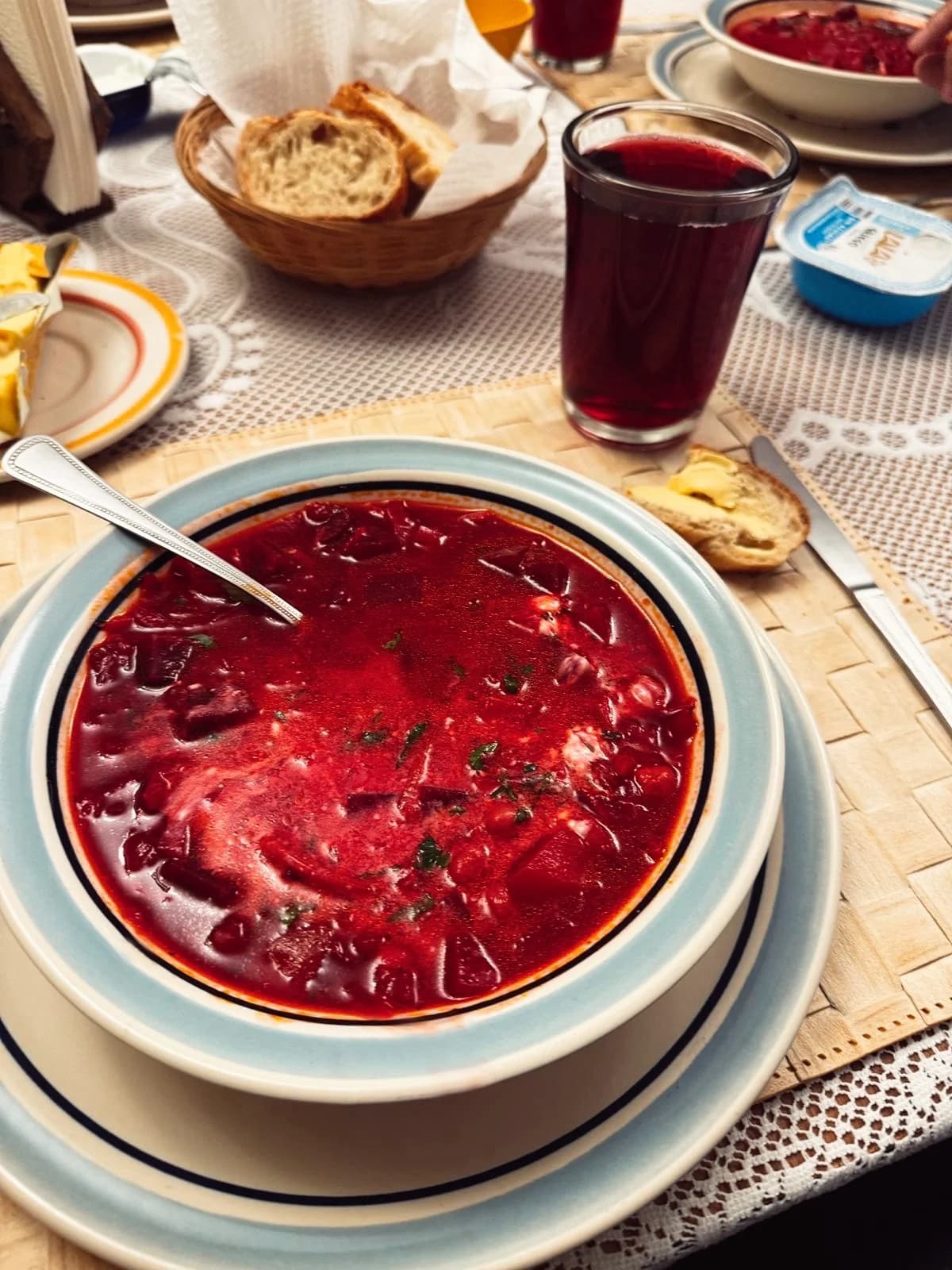
Borscht is a dish with a long history. It originated in Ukraine, but the soup has been made and cherished across much of Eastern Europe for centuries. I grew up with it too. I was born in Russia, have lived in the Netherlands since I was ten, and nowadays spend a lot of time in Mexico. Perhaps that is why borscht has come to mean much more to me than just a bowl of soup. It is a little piece of home that travels with me.
My mother taught me how to make borscht, just as her mother had taught her. I grew up in a large family, so there was often an enormous pot simmering on the stove, enough to feed us for several days. The soup is actually even better the next day, once all the flavours have had time to deepen and come together. I was always fascinated by how effortlessly my mother and grandmother seemed to make such a huge pot, as if they instinctively knew exactly how much beetroot, cabbage, potato, onion and spices to add.
Our version, however, is not entirely traditional. While borscht is often made with meat, my mother has been making a vegetarian version with beans for years. That is the borscht I grew up eating, and the one I still make today. Like so many family recipes, each generation has made their own small modifications.
I don’t have children of my own to pass this recipe on to. And yet, it doesn’t feel as though the tradition ends with me. I simply pass it on in a different way: to my friends. Whenever I’m back in Mexico, friends often ask when I’m going to make borscht again. I regularly find myself in the back of an Uber with a steaming pot of homemade soup, on my way to a dinner with friends. Once there, we heat it up together, fill our bowls, and share a dish that has now become a small tradition among my friends too.
Maybe that is what I love most about food. A recipe never stays exactly the same. Without even realizing it, everyone leaves a little bit of themselves in it. My grandmother passed it on to my mother. My mother passed it on to me. And now I pass it on to friends from all over the world, who in turn make it for others.
Because of the current war, it has been difficult for me to return to Russia for several years now, and I often feel that absence. Perhaps that is why something as simple as a bowl of borscht can mean so much. Not only because it tastes wonderful, but because it connects me to my family, my childhood, my memories, and the people I share it with today. To me, borscht is not simply a Russian, Ukrainian or Dutch dish. It is a dish that connects generations, friendships and cultures.
Masha Osipova / Moscow, Russia