It was 2020. That year, we all experienced things differently but somehow the same, shut in, trying to understand what was happening, carrying griefs we didn’t even know how to name properly. I had just had my second daughter, and from that mama-bear state I started thinking a lot about health. My own, the health of the people I love, but also the health of the environment, because I gradually came to understand that one cannot exist without the other.
Around that same time, my family and I had returned to Tepoztlán, the town where I grew up. It was pure chance that we were there just when offices, schools, and all public spaces closed. A coincidence that ended up changing my life completely. Because that confinement, in the middle of postpartum, also became an opportunity. I had time to reconnect with wonderful people I grew up with, and to take another calm look at a place and a community that had changed so much since I was a child.
And that’s when I realized that something was moving, not only in me. It was as if the whole world had stopped long enough for many of us to start asking ourselves questions we hadn’t had time to ask before.
In March 2021, the five of us became partners: Armando, an architect, who was drawn in by a project in Hueyapan, Morelos, one that left a deep mark on him and somehow ended up shaping what we later built together. There was Georgina, who had already been producing organic food for a long time and knew that relationship between agriculture and gastronomy inside out. And David, who brought a more personal concern: to explore hospitality from a sustainable but fresh perspective, without being boxed into what had already been done. Each of us brought our own piece, our experience, and also our stubbornness, because doing something like this takes quite a bit of stubbornness.
From there, little by little, the idea began to take shape. It didn’t arrive fully formed, not at all. It was more a matter of gathering pieces among the five of us. We needed an example of how to do things differently. Not speeches, not theory alone, but a place where you could see, touch, even smell, how consumption and waste can be connected in another way. A transparent place, where you wouldn’t have to imagine where what you eat comes from or where what you throw away goes.
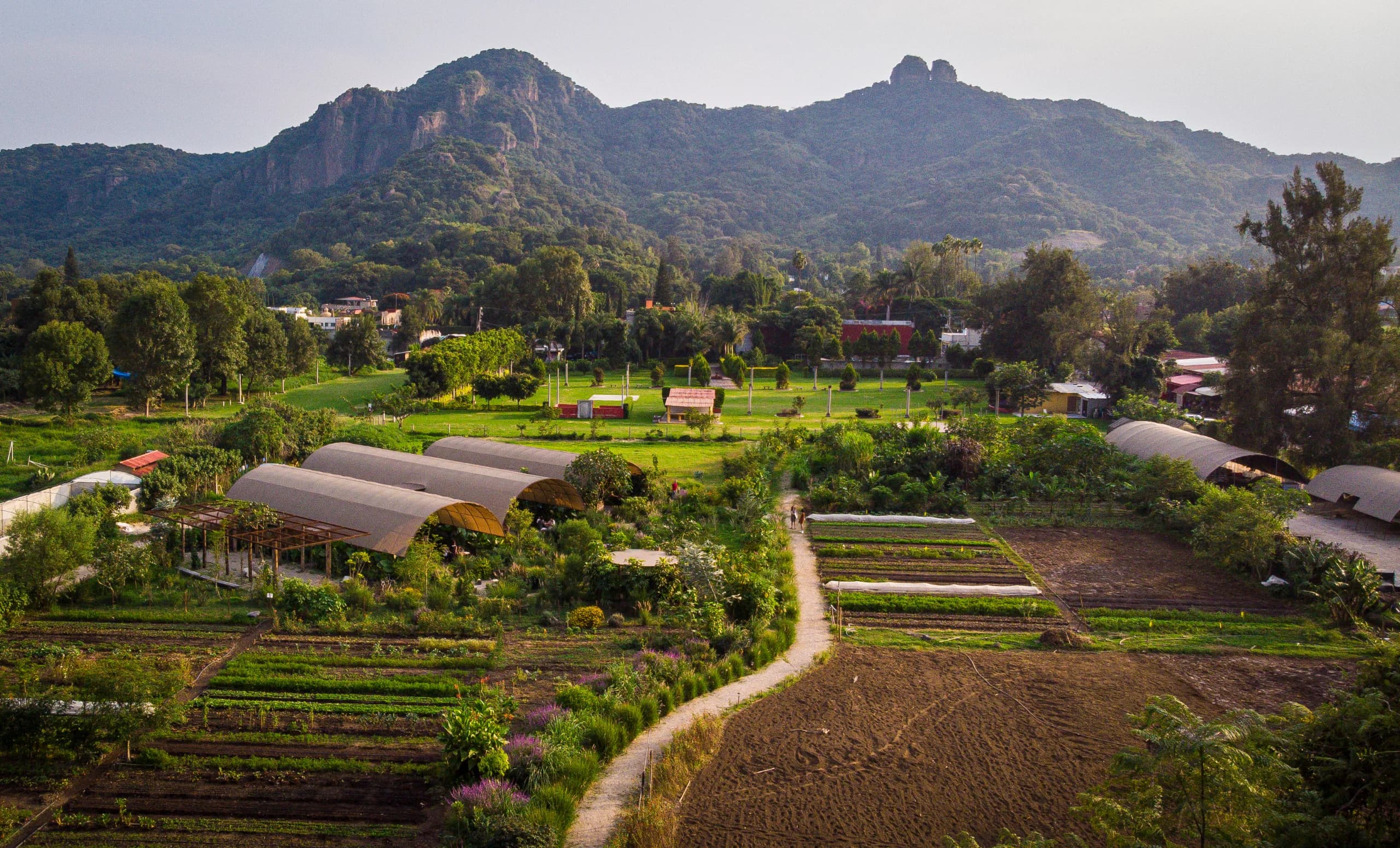
When we arrived, the land was nothing but scrub. A vacant hectare, overgrown with weeds, in the heart of Tepoztlán. And there, with little more than the idea and the desire to make it happen, we began imagining something that would be a circle. Production, consumption, waste, and back to life. Going around and around, regenerating itself. We built with what was there. Old greenhouse structures that we salvaged, wood that already had a history, traditional construction techniques from here, such as stone bars. We tried to intervene as little as possible in the soil that wasn’t permeable. We partnered with Sistema.bio to integrate technologies such as biodigesters to treat water, solar energy, and channels to keep rainwater from running off.
And we learned how to produce without destroying what was already alive underground—the fungi, the microorganisms, all those unseen things that sustain everything else. That’s why we do almost everything by hand: little machinery, a lot of care. We planted milpa, heirloom corn in several colors, squash, beans, quelites, and flowers. We also began establishing food forests; we now have six, although they’re still young. Today we have more than 150 species planted there, including vegetables, fruit trees, aromatic and medicinal plants.
And from all that harvest, working with chef Marco Cruz, the restaurant menu began to emerge. Whatever we don’t grow ourselves, we buy from organic and local producers, so we don’t break that chain of proximity and quality.
At the end of last year, we took another step: an ethnobotanical agroforestry nursery. There, we’re propagating plants for ecological restoration projects, for productive projects like ours, and also for ornamental gardens that are more than just beautiful. This nursery is complemented by a program of workshops and discussions on territorial resilience, in partnership with Concentrarte AC, designed primarily for children and young people, so they can learn about the land and recognize it as their own. It’s our latest arm, the one that goes beyond enjoyment and production, toward social and environmental impact.
Because truly restoring a place also requires recovering the knowledge that already existed about the plants here—how to use them, how to propagate them. Planting and harvesting water, that’s what we call it, through reforestation. That’s the next piece of this story, which still isn’t finished being written.
Ana Coll / Tepoztlán, Morelos