The Enduring Power of the Herb
The De La Cruz–Badiano Codex
Genoveva De La PeñaJuly 27, 20266 min read
In every culture and across all time, living beings have sought to heal. To find the equilibrium that returns us to a state of health — health understood as the absence of disease.
Every people has made the journey there and back, seeking to understand the paths that must be traveled to move from illness back to health. There are no shortcuts.
The Greeks believed that character was determined by the combination of the Four Humors. Each humor corresponded to a cosmic element: heat to fire, cold to air, moisture to water, and dryness to earth. Black bile corresponded to earth, yellow bile to fire, phlegm to water, and blood to air. In Problem XXX, Aristotle argues that those with an excess of black bile were exceptional individuals. Thus, diseases arose from the predominance or deficiency of a given quality.
In the Vedas of India, contained in the Upanishads — specifically in the Rig Veda — lie the origins of Ayurvedic medicine, whose basic precept holds that body and mind can be kept healthy and balanced through food, detoxification, physical activity, and self-care. Here again we find five elements: space (akasha), water (jala), earth (prithvi), fire (teja), and air (vayu). The combination of these five elements gives rise to three humors, or doshas: pitta, vata, and kapha.
For the Chinese, one of the fundamental concepts of well-being is
On our continent, the same held true: imbalance gave rise to disease. Where harmony existed between complementary opposites, there was health. Indigenous healers tested the effects of each plant up to the point of toxicity, learning their properties through trial and error. In this way, they compiled records of plants that served specific purposes and came to know the states to which each plant led. Through domestic practice, they arrived at the treatment of misfortune and affliction, guided by a symbolic logic that made sense to our ancestors in accordance with their concept of the person. The human body was regarded as a universe — the unit that concentrates the pulses of the organism as a coherent whole. The recipes and secrets of how to use plants were the result of countless trials carried out on their own bodies.
The remedies and properties of plants remain relevant today for relieving ailments and maintaining health. This form of medicine preserved knowledge practiced across generations over centuries, and it was born of a worldview whose wisdom bound life to the sacred.
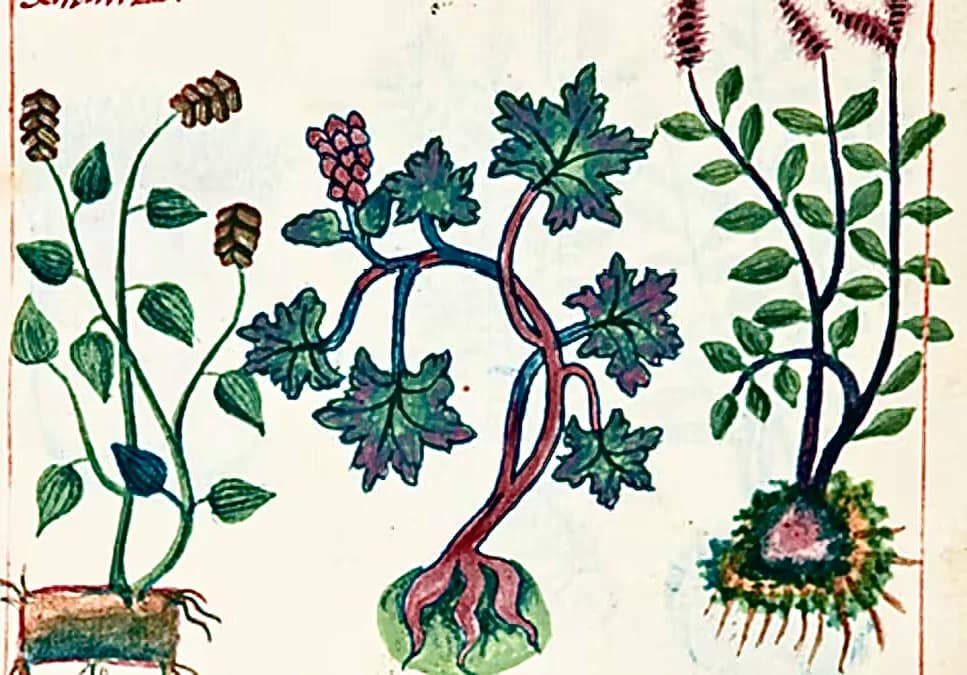
The selection process for the 227 medicinal plants featured in the Badiano Codex — chosen for their unique characteristics — is the result of the long history of traditional medicine still practiced in the territory that is today Mexico. The codex also includes remedies for diseases that did not exist on this continent, evidence of a hybrid process already underway between local and European knowledge.
Indigenous medicine takes into account vital aspects related to nature that we no longer consider when we fall ill. Precepts, beliefs, and norms have changed — and above all, the customs and habits of doing and making meaning of things have changed. Procedures changed; the harmonious rhythms and sequences, the ways of seeing and feeling in the world. What did not change were the ailments. What changed were beliefs, conveniences, and interests. The way of returning to equilibrium changed, and in its place emerged practices disconnected from the observation of nature. Textures, smells, and colors gave way to synthetic capsules in boxes. A new medicine, legitimized by a new State.
Centuries' worth of knowledge and remedies against nearly every disease were destroyed. Ancient healing traditions were banned and discredited. A telling example is how pulque came to be classified as a dangerous drink by the brewing industry — despite being one of the most nutritious, affordable, and beneficial ancestral beverages for the body and gut health.
The work of midwives, healers, herbalists, shamans, and rain-callers — all of them carriers of legitimate knowledge — was called into question. Dialogue with the forces of the world ceased, and negotiation with other forces began.
Fear took hold. Fear of pain, of discomfort — rather than receiving a symptom as something profound, as a call to care for and cleanse the body. The notion of the body and its ecosystems was transformed.
We celebrate the special edition of the Badiano Codex published by UNAM — not only as a book of impeccable and beautiful craftsmanship, but as a legacy that endures through time, memory, and the culture of the Mexican people. We turn our gaze once more toward this knowledge, which holds the work of entire generations of research devoted to preserving health, diversity, and life.
The human body has not changed significantly from before the colonial period to the present day. What has changed are diseases and their causes: problems tied to the contamination of land, food, and water; to sedentary lifestyles; and to the absence of time for pleasure and self-care. Ailments of the soul have also emerged, giving rise to new physical and mental pathologies, and to the cultural diseases that afflict us today.
From the leaves of many plants we obtain infusions that nourish us, regulate our bodily functions, and return our bodies to balance; from their macerated flowers we draw scents and flavors that bring us pleasure and cleanse us. Plants contain information that transforms into medicine — into healing and regenerating substance, into balm and ointment, into elixir or simple drink that brings relief and a sensation of freshness, warmth, and well-being. Plants give us perfumes, honeys, and medicine; they gladden us and nourish us. They have their own secret life. They photosynthesize. They relate to one another and to animals, fungi, and people. They employ remarkable mechanisms to attract insects and be pollinated, perpetuating an tireless sequence of reproduction.
Since each one is indispensable in the chain of life, it is worth heeding their properties and using them to care for ourselves.
I dedicate these lines in recognition of those who created this Codex, their ritual practices, and their customs. With gratitude to all who have tended our seeds and their infinite diversity.
Bibliography
Aristotle, El hombre de genio y la melancolía. Problema XXX I, Gredos. Barcelona, España.
Upanisads, Prologue by Raimon Panikkar. Ediciones Siruela, 2001. Madrid, España.
The De La Cruz–Badiano Codex
This text accompanied the presentation of the UNAM special edition of the De La Cruz–Badiano Codex at the 44th International Book Fair (FIL) at the Palacio de Minería in February 2023.