I discovered it by accident, and ever since then, I’ve never stopped eating it.
Almost all foods are part of the culture in which we grew up. I first encountered caimito at the age of 33; before then, I had never tasted it. I received three in a separate bag known as a “pilón,” which in Mexico is commonly given as a gift when you’ve made a sizable purchase of other products. Luis, the owner of “El Primo” Fruit Store (48th Street at the corner of 55th, Centro), gave it to me.
When I was teaching at an art school, I would always go out in the middle of the morning to buy a piece of fruit, a xec or xe'ek', (a mixture of various fruits or vegetables), or some fresh juice. “El Primo” was the only healthy-food outlet in the vicinity.
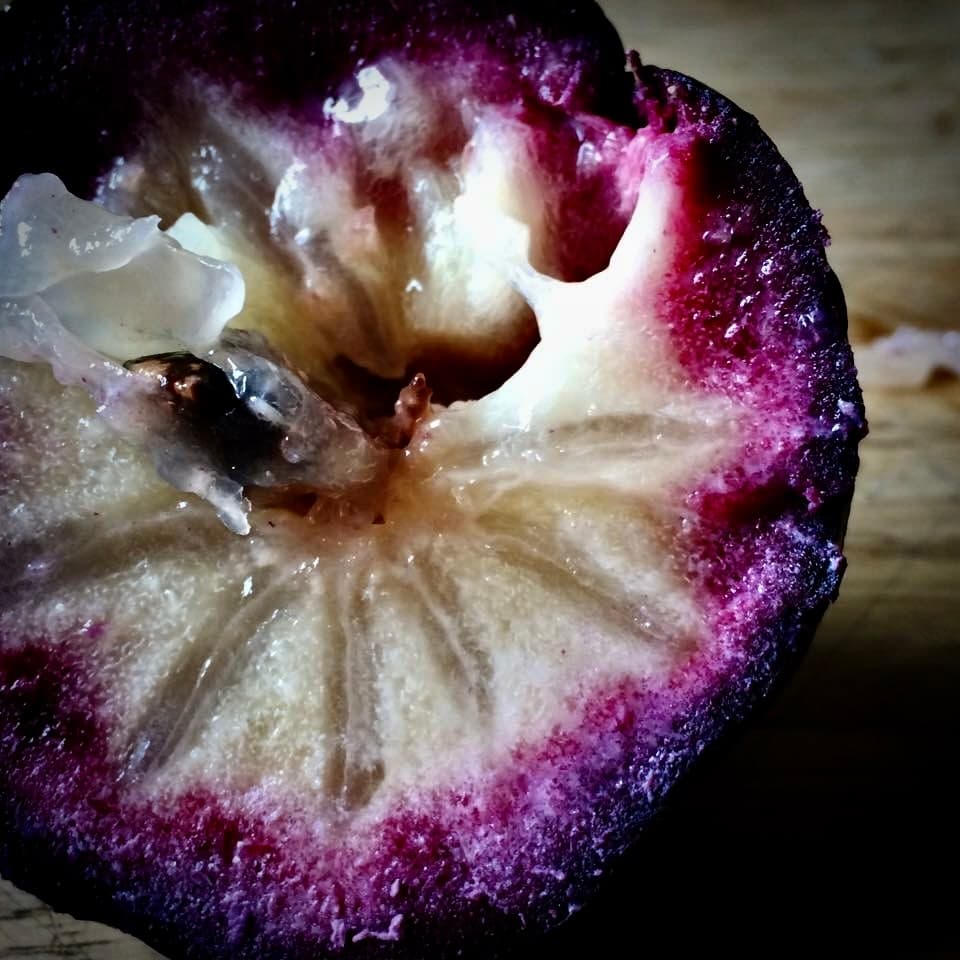
When I got to my kitchen, I discovered it. I examined it carefully and was struck by the fact that, when I opened it, it spilled a kind of very sticky white milk. I tasted it and found a fruit with a delicious flavor and a consistency I had never encountered before. The sticky milk ran down and made your lips stick together. A strange texture: juicy, sweet flesh. Purple on the outside and white inside, fading to an almost transparent hue. That was how I came to know caimito, which is harvested from February to June and contains vitamins A, B, and C, as well as calcium and phosphorus. In Yucatán, it is eaten in season for its flavor and medicinal properties. I eat it because I like having discovered it as a revelation from nature.
It belongs to the sapodilla family, and its seeds come in three colors: black, white, and a line of Mexican pink. The fruit is cut in half, revealing a white star at the center that turns deep purple toward the edges. I’ve noticed that if you put it in the refrigerator and eat it cold, it reduces the milk, or latex, that oozes from inside.
As a huach (a woman from elsewhere) who has put down roots in Yucatán, I began discovering other local fruits such as ciricote, huaya, anona, and so on, but none like caimito. When we migrate, a mosaic of new colors, smells, flavors, and textures appears in our new surroundings, gradually becoming part of our everyday diet and inviting us to belong. If you come during harvest season, I can let you try a delicious caimito.
Genoveva De La Peña / CDMX